
Guide Round pans
8-inch vs 9-inch cake pan
Learn how to convert an 8-inch round cake pan to a 9-inch round pan, why the difference is about 27%, and when to adjust bake time.
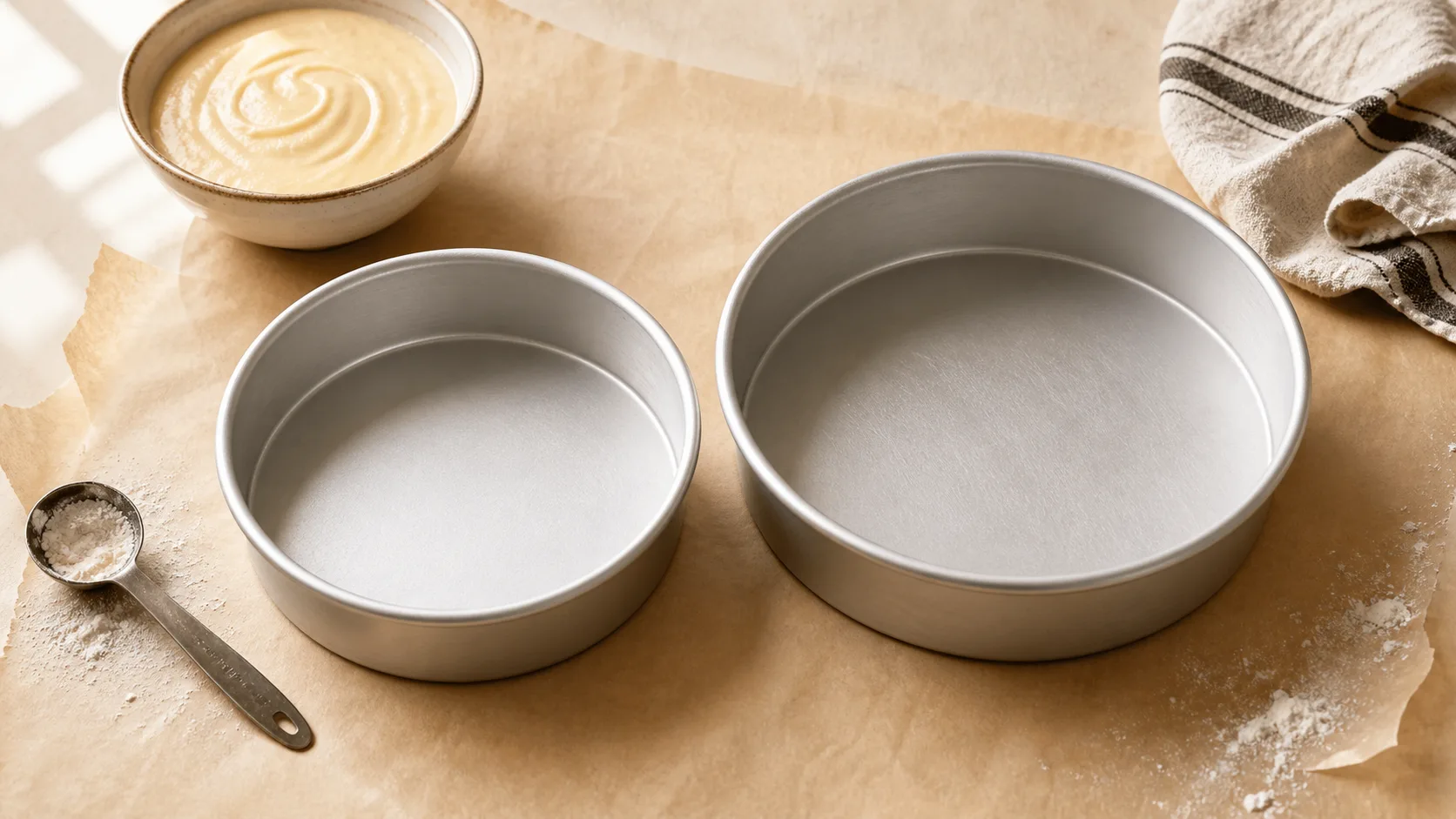
Quick answer
A 9-inch round cake pan is about 27% larger in footprint than an 8-inch round pan. To keep the same cake height, multiply the ingredients by about 1.27. If you bake the original 8-inch batter in a 9-inch pan without scaling, the cake will be thinner and will usually need an earlier first check.
What this conversion means
This is one of the easiest pan swaps to underestimate because the pan names sound close. The diameter only changes by one inch, but the batter spreads in every direction, so the extra space is closer to a quarter of the original pan than to a small trim.
For a casual snack cake, a thinner 9-inch layer may be fine. For a layer cake that must stack cleanly, the difference is more visible: the cake will be shorter, the crumb may dry faster, and the top can set before the interior has the same plush height you expected from the 8-inch version.
Calculator setup
- Original pan: round, 8-inch diameter, 2-inch depth, 1 pan.
- Target pan: round, 9-inch diameter, 2-inch depth, 1 pan.
- Use Scale recipe mode. The target/original footprint ratio should read about 1.27x.
Step-by-step use
- Enter the original recipe pan first, including the number of layers the recipe expects.
- Enter the target pan you actually own. Keep the depth at 2 inches unless your pan is clearly taller or shallower.
- Choose Scale recipe when you want the target cake to look like the original. Choose Keep batter when you only want to know how the unscaled recipe will behave.
- Use the result as a mixing guide, then judge the final batter level in the pan before baking.
Why the math works
Round pan area is pi x radius x radius. An 8-inch round pan has a 4-inch radius, so its footprint is about 50.3 square inches. A 9-inch round pan has a 4.5-inch radius, so its footprint is about 63.6 square inches.
The same-height scale is 63.6 / 50.3 = 1.26, rounded to 1.27. That is why one extra inch of diameter is not a small baking change.
Worked example
Suppose your recipe makes one 8-inch round layer with 300 g flour, 300 g sugar, 240 g liquid, and 3 eggs. The same-height 9-inch version uses a 1.27x multiplier, so the dry and liquid ingredients become about 381 g flour, 381 g sugar, and 305 g liquid.
The eggs need a practical decision. Three eggs times 1.27 is 3.81 eggs, so the cleanest method is to beat a fourth egg and use most of it by weight. If you do not want that precision, bake the unscaled recipe as a thinner 9-inch layer and check early.
Ingredient and timing notes
For ingredient scaling, weighing is cleaner than trying to measure 1.27 times every cup measure. Flour, sugar, liquid, butter, and cocoa scale straightforwardly. Eggs are the awkward part: beat the egg first, then weigh or measure the portion when the multiplier creates a partial egg.
Bake time does not scale at the same rate as ingredients. A correctly scaled 9-inch cake may bake near the original window, while an unscaled 9-inch cake is shallower and should be checked earlier. Use the timer as a reminder, not as a decision.
Fill and doneness risks
- If you move an 8-inch recipe into a 9-inch pan without scaling, the batter layer is shallower. Start checking earlier than the recipe says, especially for butter cakes that dry out when overbaked.
- If you scale up to 1.27x, keep the same oven temperature at first, but trust visual cues, a clean or nearly clean tester, and spring-back in the center more than the timer.
Common mistakes
- Assuming one extra inch means only a tiny batter change.
- Scaling ingredients but forgetting that a dark or glass pan can brown faster.
- Using the ratio for cheesecake or foam cakes without checking the recipe's pan-specific instructions.
Before you bake
- Use the inside pan diameter, not the outside rim.
- Keep the same layer count unless you are deliberately changing the cake format.
- Check whether the target pan is light metal, dark metal, glass, or ceramic.
- Start checking early if you choose not to scale the recipe.
When not to use this shortcut
Do not use this simple ratio for cheesecakes, soufflé-style cakes, angel food cakes, or recipes that depend on a very specific pan height. Also avoid scaling eggs casually in fragile cakes unless you can weigh beaten egg.