
Guide Fill level
How full to fill a cake pan
Learn a safe cake pan fill rule for converted recipes, why 1/2 to 2/3 full is usually safer, and when deeper pans need extra caution.
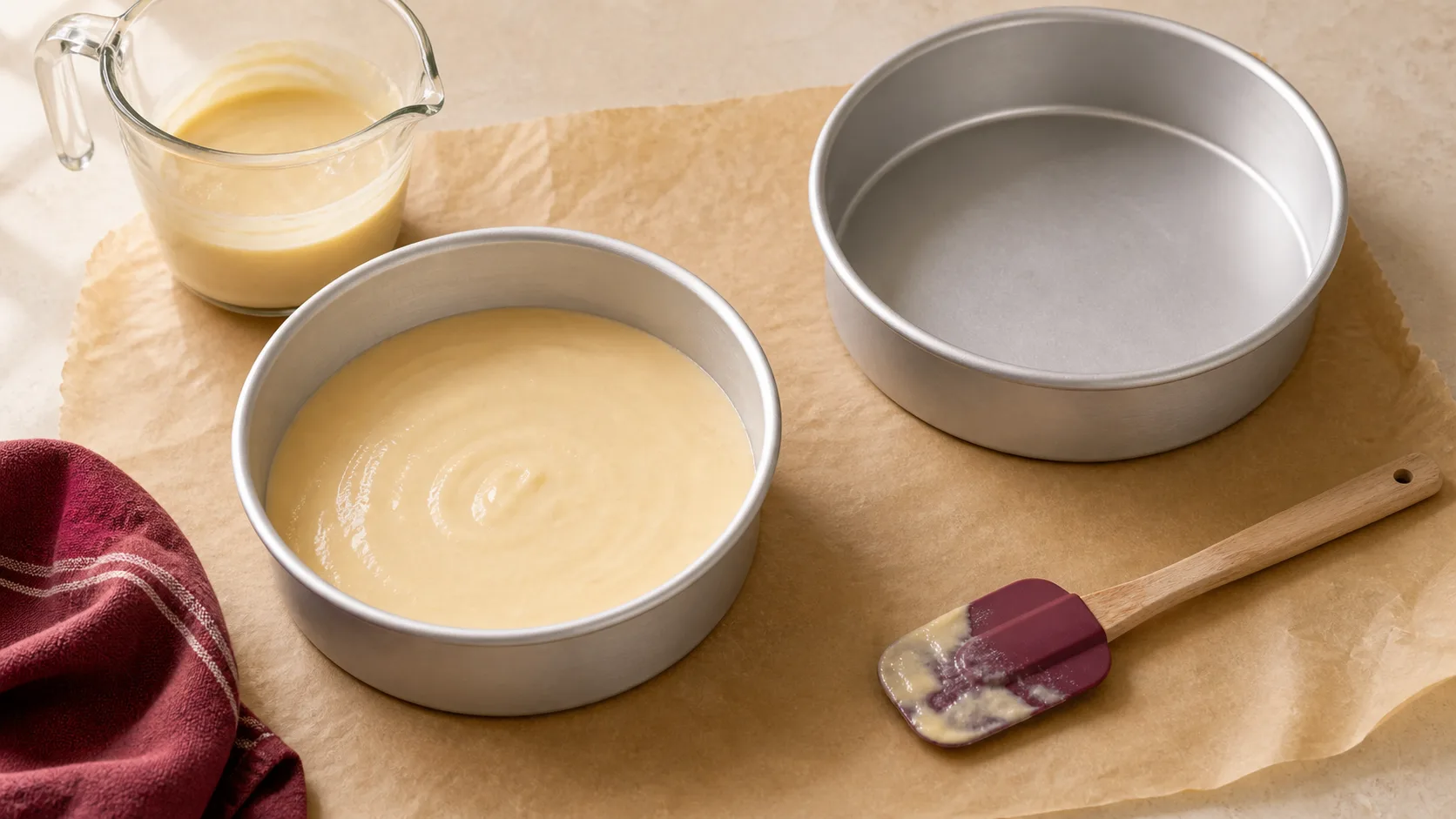
Quick answer
After converting a cake recipe, fill most cake pans about half to two-thirds full unless the recipe or pan maker gives a specific instruction. Some Bundt and dense cakes may tolerate closer to three-quarters full, but that should be a recipe-aware choice, not a default.
What this conversion means
Fill level is the final sanity check before the pan goes into the oven. It is where math meets the real batter in front of you.
Most cake batters need room to rise. The exact amount depends on recipe style, pan shape, and leavening, but a half to two-thirds full target is a safer default for ordinary cakes than pushing the pan close to the rim.
Calculator setup
- Use Keep batter if you are asking whether the original recipe can fit in the target pan.
- Use Scale recipe if you want the same layer height.
- Read the target fill result as a risk signal: around 50% is conservative, 60% to 67% is common, and above 70% needs recipe-specific caution.
Step-by-step use
- Use the calculator to estimate target fill before mixing if you are changing pan size.
- After mixing, look at the actual pan. Batter texture and trapped air can change the visual fill.
- If the pan is too full, stop pouring. Bake the extra batter separately.
- Write down what worked so the next bake starts from your real pan, not only the recipe pan.
Why the math works
The calculator estimates fill by comparing batter volume with target pan volume. A simplified model is: full pan volume = pan area x pan depth; estimated batter height = batter volume / target pan area; fill percent = batter height / target pan depth.
The important question is whether the batter height is similar to the recipe's original setup and whether enough room remains for rise.
Worked example
If a conversion says the target pan will be 67% full, that is usually within the practical range for many ordinary cakes. If it says 78%, treat that as a warning even if the pan looks like it can hold the batter on the counter.
Cold batter does not show its final rise. Once heat activates leavening and trapped air expands, a pan that looked merely full can overflow, dome heavily, or bake with a wet center and overdone edges.
Ingredient and timing notes
High-rising batters need more headroom. Dense pound cakes and some Bundt-style batters can sometimes tolerate a higher fill, but only when the recipe expects that shape.
If your conversion creates a shallow layer, check early. If it creates a deep layer, be patient, lower the rack if needed, and protect the top if it browns before the center sets.
Fill and doneness risks
- Overflow is only the obvious risk. Too much batter can also rise above the rim, collapse, stay gummy in the center, or over-brown at the edges before the middle sets.
- Extra batter can become cupcakes or a small test layer. That is more reliable than forcing the entire recipe into a pan that is already too full.
Common mistakes
- Pouring all batter into the target pan because the calculator scale looked close.
- Forgetting that fruit, nuts, and chocolate chips reduce free space and can slow the center.
- Using the same fill habit for every cake type.
Before you bake
- Look at the actual batter level after pouring.
- Reserve extra batter before it reaches the rim.
- Bake extra batter as cupcakes, not as a forced overfill.
- Record the fill result if this is a recipe you will repeat.
When not to use this shortcut
Do not use a universal fill percentage as the only rule for angel food cakes, chiffon cakes, cheesecakes, steamed cakes, flourless cakes, very dense fruit cakes, or novelty pans with detailed cavities.