
Guide Loaf pans
9 x 5 vs 8 x 4 loaf pan
Compare 9 x 5 and 8 x 4 loaf pans, convert quick bread batter safely, and learn why loaf pan depth and sloped sides matter.
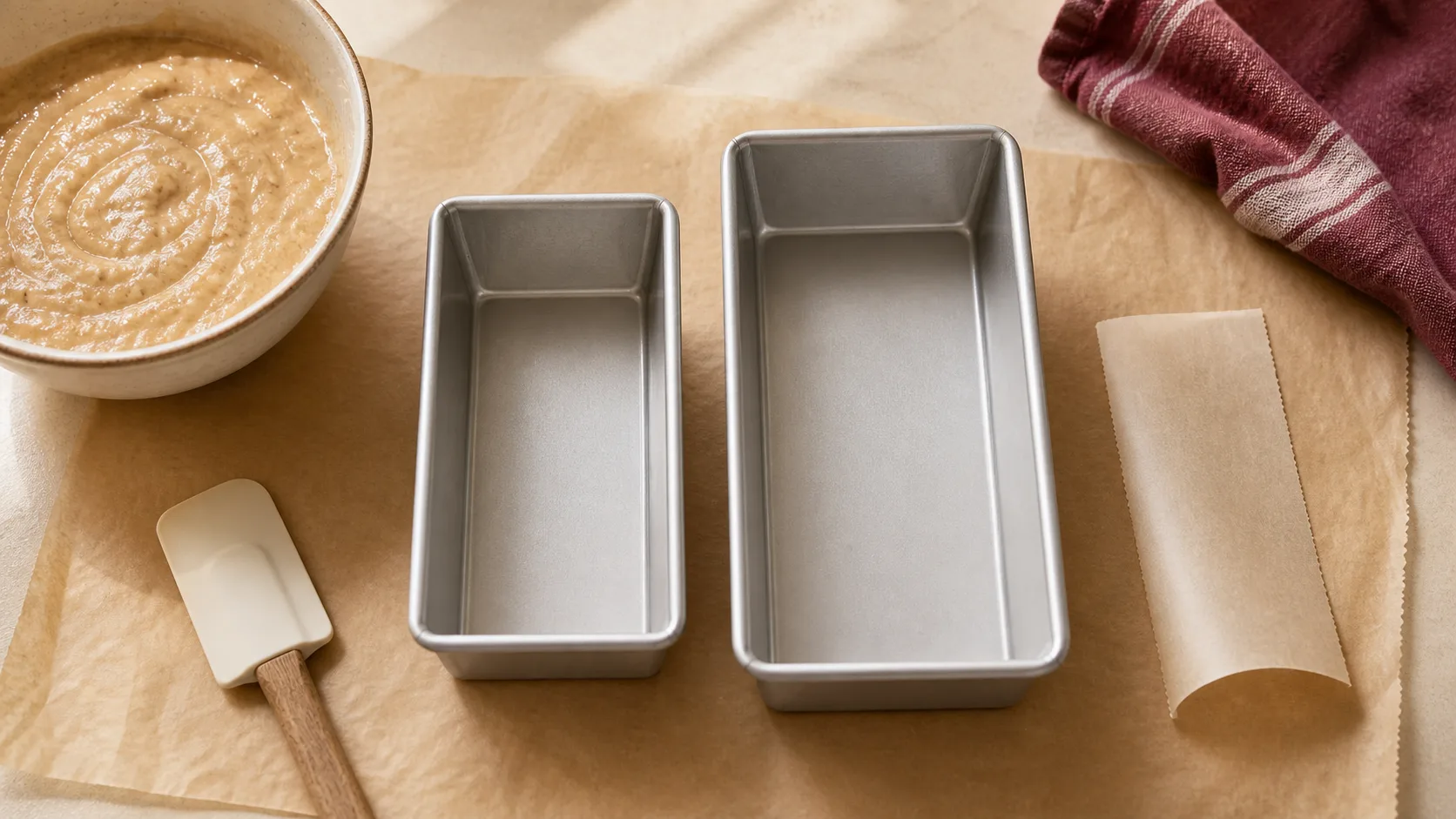
Quick answer
A 9 x 5 loaf pan has 45 square inches of rectangular footprint. An 8 x 4 loaf pan has 32 square inches. For the same batter height, an 8 x 4 recipe needs about 1.41x batter in a 9 x 5 pan; a 9 x 5 recipe should be scaled to about 0.71x for an 8 x 4 pan.
What this conversion means
Loaf pans are less standardized than flat cake pans because many have sloped sides. Still, the top footprint gives a useful warning: a 9 x 5 pan is much wider than an 8 x 4 pan.
Quick breads are especially sensitive to this. Too much batter in a smaller loaf pan can produce a tall cracked top and an underbaked center, while too little batter in a larger pan can make a squat loaf that dries quickly.
Calculator setup
- Original 8 x 4 loaf: rectangle, 8 x 4 inches, about 3-inch depth, 1 pan.
- Target 9 x 5 loaf: rectangle, 9 x 5 inches, about 3-inch depth, 1 pan.
- Use Keep batter to see whether your existing loaf recipe becomes too shallow or too full.
Step-by-step use
- Enter the loaf pans as rectangles with their inside length and width.
- Use the depth field if one pan is noticeably taller.
- Check Keep batter first when moving an existing recipe into a different loaf pan.
- If the target fill looks high, hold back batter for muffins or a mini loaf.
Why the math works
Using the top-line rectangle footprint, 8 x 4 = 32 square inches and 9 x 5 = 45 square inches. 45 / 32 = 1.41.
Loaf pans often have sloped sides and rounded corners, so published cup capacities vary more than the simple rectangle math. The ratio is still useful, but fill level matters more for quick breads than for flat bars.
Worked example
A quick bread recipe written for a 9 x 5 loaf pan can overwhelm an 8 x 4 pan. The footprint ratio from 9 x 5 to 8 x 4 is 32 / 45, or about 0.71x, before accounting for the sloped sides common in loaf pans.
If you only own the smaller pan, do not pour in the full batter by habit. Fill to a safer level, then bake the remainder as muffins or a mini loaf so the main loaf has room to rise and set.
Ingredient and timing notes
Banana bread, pumpkin bread, and pound cake often need a center-focused doneness check. A toothpick can come out with moist crumbs, but it should not show wet batter.
If a larger loaf pan makes the batter shallow, start checking earlier and expect less dome. If a smaller pan makes it deep, expect a longer bake and possible tenting.
Fill and doneness risks
- A 9 x 5 recipe in an 8 x 4 pan can rise too high, crack aggressively, or stay underbaked in the center. Hold back batter if the smaller loaf pan is above about two-thirds full.
- An 8 x 4 recipe in a 9 x 5 pan bakes as a shorter loaf and may dry out faster, so start checking earlier.
Common mistakes
- Treating all loaf pans with the same label as equal.
- Filling a smaller pan too high because quick bread batter looks stable when cold.
- Changing pan size and oven temperature at the same time without a reason.
Before you bake
- Check loaf pan fill from the side, not only from above.
- Expect smaller loaf pans to need more center-focused checking.
- Use extra batter intentionally instead of overfilling.
- Let quick breads cool before slicing so the center can finish setting.
When not to use this shortcut
Do not force a full 9 x 5 quick bread batter into an 8 x 4 pan unless the recipe specifically says it works. Dense banana bread, pumpkin bread, and pound cake need enough depth to look right, but too much depth can leave a gummy center.