
Guide Bundt pans
Bundt pan conversion boundaries
Learn why Bundt pans should be checked by capacity and recipe type, not just by surface area, before converting a cake recipe.
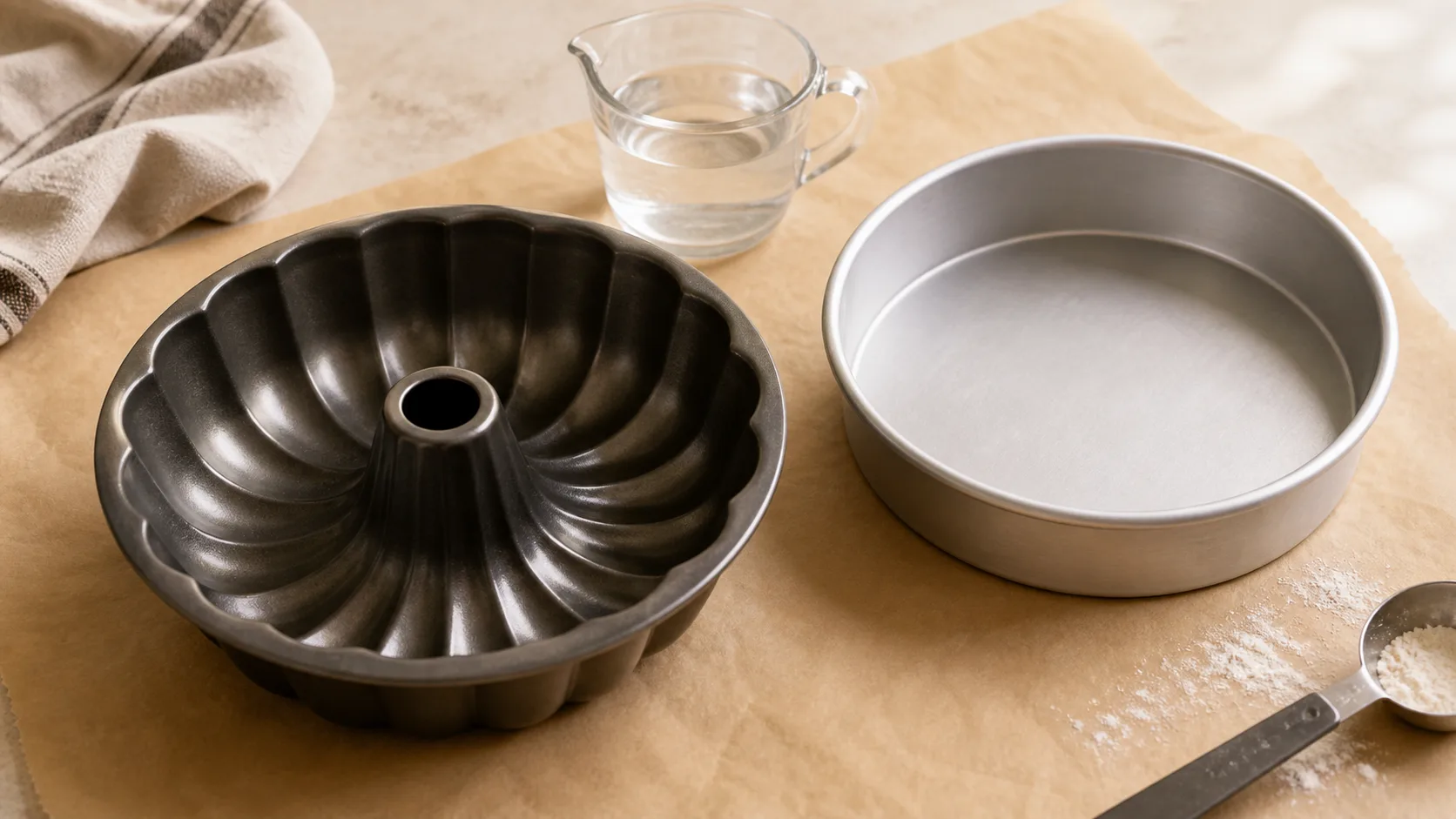
Quick answer
Do not convert Bundt pans by simple area ratio alone. Bundt and tube pans have a center opening, decorative walls, varying capacity, and different heat flow. Measure the pan with water, compare usable capacity, and fill only to the recipe or pan maker's recommended range.
What this conversion means
Bundt pans are beautiful because of their shape, and that shape is exactly why simple area math breaks down. The center tube, fluted walls, heavy metal, and decorative surface all change how batter rises and browns.
The calculator can help you compare ordinary pan volume and fill risk, but a Bundt conversion should be treated as a capacity and recipe-structure decision, not a clean geometry swap.
Calculator setup
- Use the calculator only for rough comparison with ordinary round, square, or rectangle pans.
- For a Bundt pan, measure capacity with water, then leave rise space instead of using the brim-full number as a batter target.
- If converting from a 9 x 13 or layer cake recipe, compare both capacity and recipe type before baking.
Step-by-step use
- Measure the Bundt pan capacity with water before deciding whether a recipe fits.
- Compare the recipe's expected pan capacity with the Bundt's usable capacity, leaving room for rise.
- Use the calculator to understand the original pan's footprint and depth, but do not use area as the only decision.
- Grease and flour the pan according to the pan style because release is part of the conversion risk.
Why the math works
Bundt pans do not have a simple flat footprint like a round or rectangle pan. The center tube removes volume, while fluted sides increase surface area and browning.
A water test gives practical capacity. But full capacity is not safe batter capacity, because cake batter expands. Treat the measured number as a limit, not a fill goal.
Worked example
If a layer cake recipe appears to have enough batter for a Bundt pan, that still does not make it a good Bundt recipe. A Bundt pan asks the batter to release from detailed walls and bake around a center tube.
A sturdy butter cake may handle that environment well. A delicate foam cake may not. The conversion decision should begin with capacity, but it should end with recipe structure and release risk.
Ingredient and timing notes
Dense butter cakes and pound cakes are more Bundt-friendly than delicate foam cakes. Batters with a strong structure can climb and release better from detailed walls.
Because decorative pans brown differently, start checking before assuming a long bake is needed. The outside may look done while the inner ring still needs time.
Fill and doneness risks
- Too much batter can overflow around the center tube or distort the decorative crust. Too little batter can fail to reach the intended shape.
- Heavy decorative pans brown faster than plain aluminum, so doneness timing and oven position may need adjustment.
Common mistakes
- Assuming every Bundt pan with the same cup rating behaves the same.
- Filling to measured water capacity instead of safe batter capacity.
- Moving a delicate layer cake into a Bundt pan just because the batter amount fits.
Before you bake
- Measure capacity with water, then leave rise space.
- Use Bundt-friendly batters with enough structure.
- Grease the pan based on its surface detail.
- Treat decorative browning and release as part of the conversion.
When not to use this shortcut
Avoid converting delicate sponge, angel food, chiffon, or cheesecake formulas into Bundt pans unless the recipe is written for that structure. Also avoid assuming every 10-cup Bundt behaves like every other 10-cup Bundt.