
Guide Formula
Cake pan area formula
Learn the cake pan area formulas for round, square, and rectangular pans, and see how area ratios become practical recipe scaling multipliers.
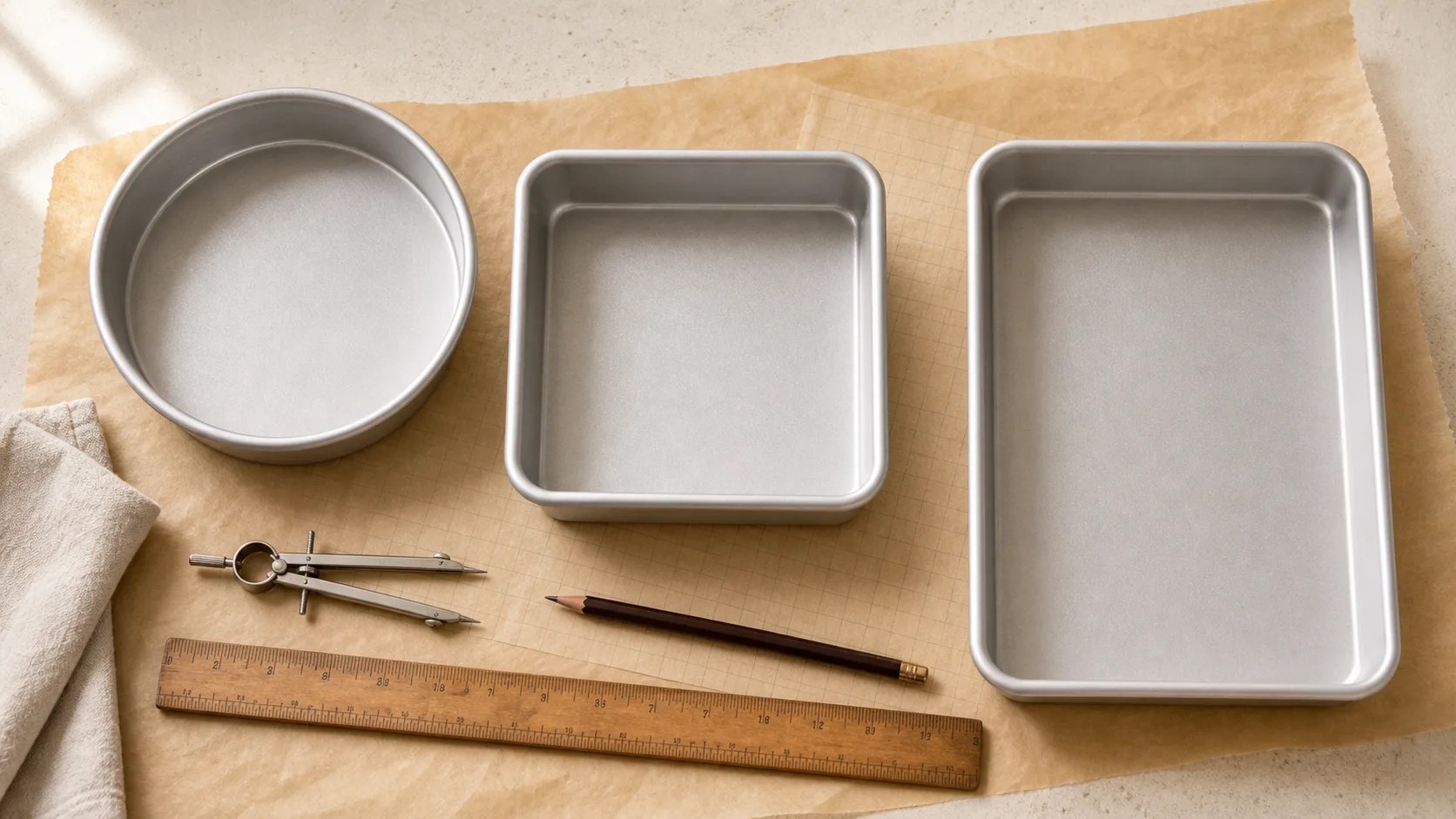
Quick answer
For most same-depth cake pan swaps, compare the bottom surface area of the original pan with the bottom surface area of the target pan. Use target area divided by original area as the recipe scaling factor.
What this conversion means
Pan conversion starts with area because batter height controls a large part of how a cake bakes. If the same amount of batter spreads over more area, the layer gets thinner; if it spreads over less area, it gets deeper.
Area is not the whole story, but it is the best first filter for ordinary round, square, and rectangular pans. It gives you a repeatable number before you start making recipe judgment calls.
Calculator setup
- Enter the original pan shape, inside dimensions, depth, and layer count.
- Enter the target pan shape, inside dimensions, depth, and layer count.
- Choose Scale recipe when you want the same approximate layer height.
Step-by-step use
- Measure inside dimensions, not outside rim dimensions.
- Choose the pan shape in the calculator and enter the measured size.
- Set layer count before comparing ratios, because two pans double the footprint.
- Use the area ratio for ingredient scaling, then use fill level for safety.
Why the math works
Round pan area is pi x (diameter / 2)^2. Square pan area is side x side. Rectangular pan area is length x width. For multiple pans, multiply the area of one pan by the number of pans.
The calculator uses this footprint ratio because batter height drives much of the baking behavior. If the batter sits at a similar depth in the target pan, the center has a similar distance to bake through.
This does not guarantee the same bake time, but it is a better first estimate than guessing from diameter or cup capacity alone.
Worked example
For a round pan, the calculator first turns diameter into radius. An 8-inch round has radius 4, so its area is pi x 4 x 4, or about 50.3 square inches. A 9-inch square pan is easier: 9 x 9 equals 81 square inches.
If you move from one 8-inch round to one 9-inch square, the same-height scale is 81 / 50.3, or about 1.61x. That sounds large, but it is exactly what happens when a round layer is spread into a wider square footprint.
Ingredient and timing notes
When an article or recipe gives a pan size, it usually means the common inside baking size, but older or decorative pans can differ. A small measurement difference changes area, especially for round pans.
For volume-heavy recipes, area still matters because two pans with the same cup capacity can make very different cake heights. Use area to preserve height and capacity to prevent overflow.
Fill and doneness risks
- Area math tells you the batter quantity needed to preserve height. It does not prove the pan is safe to fill.
- If the scaled batter would fill the target pan above about half to two-thirds full, treat it as an overflow warning.
- If the new pan makes the batter shallower, start checking earlier. If the new pan makes the batter deeper, expect a longer bake and watch for over-browned edges before the center sets.
Common mistakes
- Using diameter difference instead of area ratio.
- Forgetting to multiply by the number of layers.
- Using outside pan measurements from rim to rim.
Before you bake
- Measure inside dimensions at the usable baking surface.
- Treat square and rectangle pans as footprint problems first.
- Multiply area by pan count before comparing recipes.
- Use depth only after the area ratio tells you the batter scale.
When not to use this shortcut
Do not rely on area-only scaling when pan depth changes a lot, when you are using a Bundt, tube, heart, oval, or novelty pan, or when the recipe is unusually structural: angel food, chiffon, soufflé-style cakes, cheesecakes, or very dense fruit cakes.